
Why Property Gurus Are Stuck in 2010 — And How AI Is Changing the Game
In 2010, you could get ahead with hustle alone. You could outwork the competition, knock on doors, and build your portfolio by sheer persistence.
In 2025, that same approach is slow, inefficient, and blind to the biggest edge investors have today: data.
Walk into almost any property seminar in the UK today, and you’ll hear the same script you could have heard in 2010. The same PowerPoint slides. The same “insider tips.” The same pitch for a £15,000 training package that promises to unlock the secrets of financial freedom.
The problem is, those “secrets” are ancient history.
The playbook still looks like this:
View 100 properties.
Post letters to landlords begging them to sell.
Hunt for “tired stock.”
Rely on “gut feel” to know a good deal.
That might have worked in 2010. The market was different, competition was thinner, and if you had the stamina to knock on doors and the patience to drown in spreadsheets, you could scrape an edge.
But in 2025? That model is broken.
The Old Model: Built on Hustle, Not Insight
I started investing around the tail end of that old world. Back then, hustle was everything. If you had the energy to chase deals, view property after property, and sit at the kitchen table with an owner until they signed, you could make money.
The “gurus” of that era built empires on persistence. They sold the idea that property success was about grit: who could send more letters, make more calls, and throw more offers against the wall.
The irony is, they’ve never updated the script. They’re still teaching hustle as the answer, long after the game has changed.
And here’s the truth nobody on those stages will tell you: hustle alone doesn’t win anymore. The investors who rely purely on shoe leather and charm are losing to those who’ve embraced a new edge — data.
The Market Isn’t What It Was
There are three big shifts that broke the old model:
1. Regulation
Buy-to-let in 2010 was the Wild West. Licensing was patchy, HMOs were loosely enforced, and lenders were generous. Fast forward to today, and the regulatory net is tight. Section 24 wiped out tax relief, EPC standards are tightening, and licensing is aggressive. If you’re flying blind on “gut feel,” you’ll end up owning liabilities, not assets.
2. Data Explosion
In 2010, most investors relied on Rightmove, Zoopla, and an Excel spreadsheet. Now, every metric you could imagine is online. You can track rental yields street by street. You can scrape planning applications. You can analyse ownership history. If you aren’t using data, you’re effectively competing with a blindfold on.
3. Competition
Property isn’t fringe anymore. It’s mainstream. Institutions are muscling into markets where private landlords once dominated. Crowdfunded platforms are raising millions. International investors are scouring regional towns. If you think you’ll beat them by licking stamps and sending landlord letters, good luck.
Why Most Gurus Haven’t Moved On
So why do most property trainers keep recycling the 2010 playbook?
Simple: it’s easy to sell.
“Send 500 letters to landlords” sounds achievable. “View 100 houses” feels like tangible work. People like to believe success comes from doing more of what’s familiar.
But here’s the problem: familiarity doesn’t equal effectiveness. While students are pounding pavements, institutional investors are running predictive models that identify undervalued stock before it even hits the open market.
That’s the real playing field. And if you’re paying five figures for a training course that ignores it, you’re paying for nostalgia, not strategy.
The New Reality: Systemised, Data-Led Investing
In my business, I’ve built a system I call RobBot. It’s an AI-driven toolkit that sits at the heart of every decision I make.
Here’s what it does:
Appraises 50+ deals in seconds using my exact criteria for yield, margin, and value-add potential.
Sorts opportunities by profitability and vendor motivation, so I only spend time on the best ones.
Generates negotiation scripts tailored to seller behaviour patterns. If a vendor is risk-averse, it frames the offer one way; if they’re cash-hungry, another.
Writes offers, contracts, and operational documents without me staring at Word templates for hours.
Tracks live performance across lettings, refurbishments, and cashflow, flagging issues before they become disasters.
That’s not theory. That’s running in my business today.
And while the old-school gurus are still telling people to “trust their gut,” I’m making decisions backed by thousands of data points — in seconds.
Why AI Doesn’t Replace Strategy — It Amplifies It
The predictable pushback is: “But AI doesn’t understand property. You still need human experience.”
Correct.
AI doesn’t replace the need for strategy. It doesn’t replace the judgement to know which market cycle you’re in, or the creativity to structure a win-win deal. What it does is supercharge your ability to apply that strategy at scale.
Think about it this way:
Without AI, 90% of my time used to be wasted chasing dead ends.
With AI, 90% of my time is spent executing the top opportunities.
It’s not about working harder. It’s about eliminating everything that doesn’t move the needle.
The Gurus Are Playing Checkers. AI Investors Are Playing Chess.
Here’s the biggest shift AI creates: the playing field isn’t level anymore.
The investors clinging to the 2010 playbook are competing in a slow, linear way. View. Offer. Wait. Repeat.
Meanwhile, data-led investors are compounding speed and accuracy. When I analyse 50 deals in the time it takes them to look at one, the outcome isn’t even close.
This isn’t theory. It’s happening now.
Where AI Is Already Transforming Property
If you think this is “sci-fi,” you’re already behind. AI is being applied in property across the board:
Valuation models that beat Zoopla estimates.
Predictive rent analysis that forecasts demand shifts street by street.
Automated compliance tracking that flags EPC or licensing risks before they cost you.
Conversational AI agents handling tenant queries.
Automated finance structuring that identifies the most efficient mortgage and debt solutions.
And that’s just 2025. In five years, investors who don’t integrate AI will be as outdated as those still using fax machines.
The Human Edge Still Matters
Here’s the nuance: AI doesn’t kill the need for humans. It kills the need for human inefficiency.
AI won’t walk a property and notice rising damp. AI won’t build rapport with a vendor who’s going through divorce. AI won’t spot the political dynamics of a council planning committee.
That’s where the investor’s edge lives now: not in trawling spreadsheets, but in applying human judgement where it counts most.
The winners of the next decade will be those who combine human insight with machine efficiency. Not either/or. Both.
Why Most Investors Won’t Make the Leap
If AI is so powerful, why isn’t every investor using it?
Because change is uncomfortable.
It’s easier to believe success is about knocking on more doors than learning a new system. It’s easier to keep paying gurus who tell you the old hustle still works than to admit you need to upgrade your skills.
And let’s be blunt: a lot of investors like the story of being busy. It makes them feel in control, even if they’re not actually making money.
But stories don’t build portfolios. Numbers do.
The Players Are Changing
This is why the property game is being reshuffled. The next wave of successful investors won’t be those who grind hardest. It’ll be those who systemise smartest.
The amateur landlord with a spreadsheet is outgunned.
The seminar junkie chasing 2010 strategies is outpaced.
The data-led investor with an AI stack is scaling faster, safer, and smarter.
That’s the shift.
The Summit: Where This Goes Next
At the Property Unicorn Summit this September, I’ll be pulling back the curtain on how this works in real time. Live examples. Real data. Operational systems investors can implement immediately.
Because here’s the choice every investor faces:
Stick with the 2010 playbook, grinding harder for diminishing results.
Or embrace the tools that define 2025, and position yourself for the next decade of growth.
One option feels comfortable. The other option builds wealth.
Final Thought
The gurus teaching today aren’t wrong because they were never right. They’re wrong because they’ve frozen in time.
They’re still selling the story that hustle equals success. But in 2025, hustle without data is noise.
The investors who thrive in the next decade won’t be those who knock on the most doors. They’ll be the ones who combine timeless strategy with AI systems that give them exponential leverage.
That’s not the future. That’s now.
Property Unicorn Summit this September, I’ll be showing exactly how to build an AI-powered property business. Live examples. Real numbers. Systems you can implement immediately.

Bet Everything on a property Crash. It Worked.
Bet Everything on a property Crash. It Worked.
In 2022, interest rates started rising faster than we’d seen in over a decade. Panic set in. The market wobbled. And I made a move most people would call mad:
I sold my home.
I took 15 years of experience in property and went all in—on a crash.
Why I Sold at the Peak
I could see what was coming:
Cheap money was disappearing
Yields were thinning
The commercial market was headed for a reset
So I sold my house near the peak of the market, went into cash, and moved into a rental.
It sounds backwards, right? But here’s the trick most people miss:
Using the law of diminishing rental returns, we could rent a house far nicer than we could buy. For less money, less commitment, and more flexibility.
My partner Helen did the same. Together, we freed up about £500,000 in liquidity.
Strategy in Motion: Go Where the Crash Hits First
We set up a 50/50 SPV (Special Purpose Vehicle) and went deal hunting.
Our first move?
We bought a commercial block for £345,000 in early 2023—cash.
This was right after Liz Truss’s infamous mini-budget, which tanked market confidence and made sellers more negotiable.
We put around £70,000 into cosmetic works—whiteboxed it, modernised the layout, let the commercial space, and turned three of the four flats into Airbnbs (with a tenant still in the fourth).
The Results? Not Hype—Hard Numbers
Just had it revalued at £795,000
That’s £350,000+ in equity created
Rental income: £60,000+ a year (before finance)
This wasn’t theory—it was strategy in motion.
Deal #2: Leveraging Up with Precision
With the remaining funds—and a portfolio facility secured on property #1—we bought our second site:
A block of 7 tenanted flats for £825,000.
As tenants moved out, we converted each one into boutique Airbnb units.
As of now, we’ve flipped 4 out of 7. The current valuation?
Over £1 million—and tracking toward £1.2 million once the last 3 are done.
📅 This July alone: Airbnb bookings hit £16,000 gross.
That’s enough to:
Pay out tax-free director’s loans to cover our rent
Leave the rest in the company to compound for the next deal
So... Madness or Strategy?
In under two years, without external investors, we’ve:
✅ Built a portfolio generating enough net cashflow to cover all our personal living costs
✅ Created over £500,000 in equity
✅ Maintained full control by using only the equity in our homes
Meanwhile, many higher-end homeowners are watching their valuations slide.
We moved when others froze. We bet on a crash—and we had a plan to make it work.
Your Move
Was it risky? Yes.
Was it reckless? No.
It was informed, timed, and executed with intent.
The question is—would you have done it?
👇 Drop your take in the comments.
Want to see how we’re building in this market, without fluff or fairy tales?
Click Here for you free copy of Property Unicorns
50% Property Price Crash Warning? Let’s Talk Facts
Scroll through social media or click on a tabloid headline, and you’ll hear it:
“The mother of all property crashes is coming.”
Some even predict drops of 30% to 50%.
Cue panic. Cue clickbait. Cue doomscrolling.
But let’s have a real conversation about property cycles, because context matters more than panic.
I scroll past doom‑scrolling headlines and guff about a “mother of all crashes.” Supposedly, we’re staring down the barrel of a 30 % to 50 % collapse. That’s terrifying. But how much of that is fear and how much is fact?
I’m digging for truth: not hype. Here’s the breakdown, pulled from data, not panic, and I’ll punch holes in the absurdity of clickbait.
Are Property Crashes Really Getting Worse?
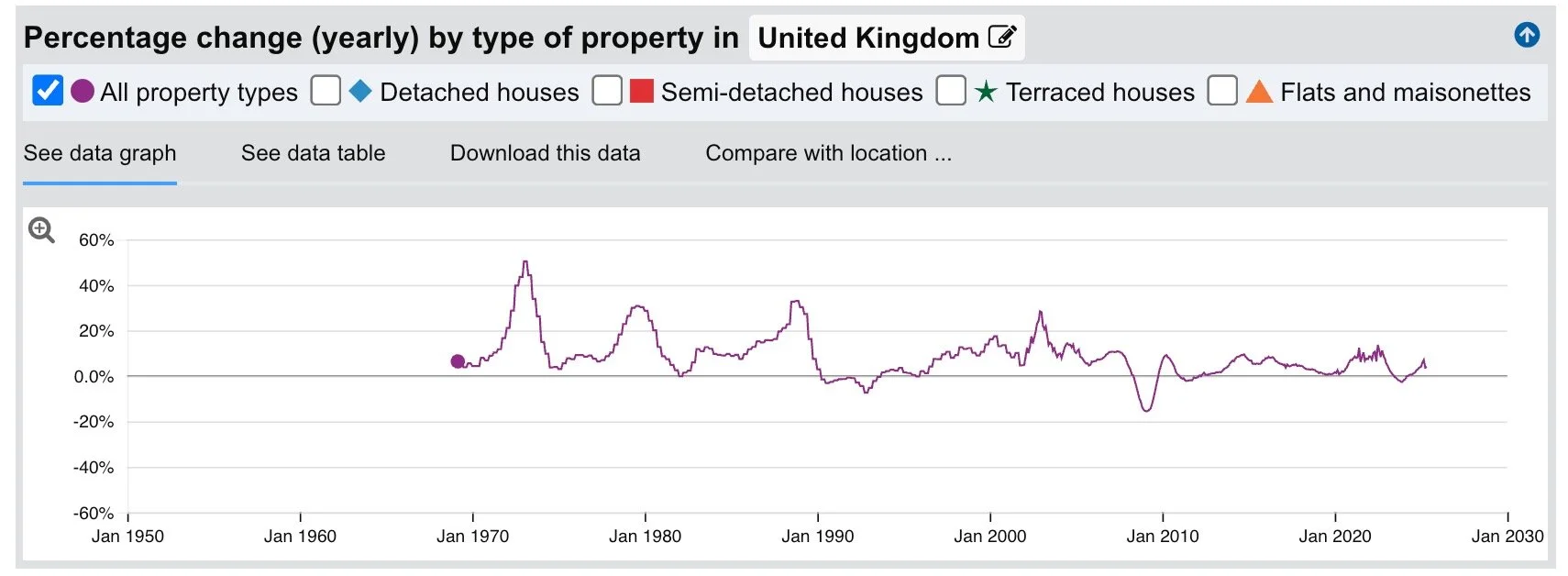
Quoted lines like “the highs are getting higher, and the lows are getting lower” sound slick. But digging into the numbers, volatility hasn’t grown, it’s softened.
Academic studies show that UK housing volatility is stabilising. A paper using ARCH/GARCH models finds three different volatility regimes—yet transitions between them are rare, meaning the market isn’t swinging more wildly now than before GOV.UK Assets+2MoneyWeek+2ResearchGate+1.
Real terms fluctuate—sure: in 2009, real house prices plunged by 16 % across the UK and 29 % in Northern Ireland Economics Help+4pearsonblog.campaignserver.co.uk+4Oxford Academic+4. But on average, real house prices grew at just +3.2 % above inflation per year between 1970 and 2019 LSE Personal Pages+15pearsonblog.campaignserver.co.uk+15SpringerLink+15. That’s resolute, slow‑and‑steady growth, not volatile freefall.
Since 2008, we’ve been living in a low‑growth, low‑volatility era. Household affordability hasn’t budged—post‑2008, real wage growth shrank to near zero, and property growth slowed accordingly Economics Help.
Why Today Feels More Volatile Than It Is
Michael Bay‑style headlines are sensational: £14,000 wiped off house values! But that often turns out to be just 3 %–5 % of value lost. It’s dramatic, but not cataclysmic.
Meanwhile, in June 2025, UK average house prices rose 3.7 % year‑on‑year, to an average of £269,000. Monthly growth was 1.4 % Office for Budget Responsibility+3GOV.UK+3The Guardian+3. Regional differences are telling: North‑East house prices jumped 7.8 % annual, London barely ticked up 0.8 % GOV.UK.
That north‑south divergence isn’t new, but it’s more pronounced: root is affordability and banking on “southern premium” no longer holds water The TimesFinancial Times.
So yes, people feel jittery—but the data says this is performance‐art. Not apocalypse.
The New Regime: Dampened Boom, Prolonged Plateau
What transformed the market?
Stricter lending post-2008 means bigger deposits and smaller leverage Financial TimesThe Times
Help to Buy schemes injected demand—but didn’t fix supply, especially in constrained areas like London The Times+5en.wikipedia.org+5pearsonblog.campaignserver.co.uk+5
Regulation and risk controls, including stress testing, have smoothed cycles.
The result: national house prices inch up rather than surge. The OBR forecasts growth of just 2.8 % in 2025, and an average of 2.5 % through 2029, bringing UK average price to around £295,000 by end of decade Office for Budget Responsibility.
This isn’t a crash lockdown….it’s a slow cruise control. More headline-friendly than catastrophic.
The Real Danger: Overleverage, Not Volatility
Sure, cycles still exist. Crashes still happen. But the bigger risk now is buyers overextended on margin, not dramatic 50 % price swings.
If you bought at the peak, stretched your deposit, or relied on future inflation to bail you out, you’re the one exposed, not the market.
This isn’t about wild cycles anymore, it’s about being prudent in a low-growth environment.
So … Is a 50 % Crash Coming?
Let’s be blunt: Noble prize-level data doesn’t back that claim.
We may expect localized corrections, regional softness, maybe a recession-prompted slowdown. But a full-blown 50 % crash across the UK? Not seeing the evidence.
What’s real is a policy-driven, technical market, not a rollercoaster. Lending standards, regulation, and demographic shifts have fundamentally changed the system.
A Better Strategy Moves Beyond Panic
If you’re in property, don’t chase the booms or fear the busts. You want a method that works in any cycle stage.
That’s where The Unicorn Concept comes in: commercial valuation models, unused housing stock, resilient income….not hype.
Summary: Flattened Cycles, Not Collapsed Markets
Insight Reality
Property crashes are deeper now No. volatility has softened.
Dramatic headlines reflect systemic risk No. often just imbalanced optics.
Real danger is leverage risk Yes, being overexposed is why people suffer.
50 % crash is likely? No, tiny chance, not across the board.
Market’s future Technical, regional, resilient, if played smart.
I’m not saying everything’s peachy. But crying wolf about apocalypse won’t help anyone. If you’re investing or advising, you’re better off seeing the signal, not the noise.
Property Unicorns (that inevitably-shameless plug) walks you through strategies that survive cycles, ignore doom, and actually build value.
👉 Grab your free copy here of my book and learn how smart investors are still creating income, equity, and scale, even in a “crisis.”

46 Applications. One Flat. This Is the Crisis.
Last week, I listed a flat in Chester. Within 48 hours, it had 46 enquiries.
Forty-six. For one flat.
This wasn’t a luxury penthouse or underpriced deal, it was a standard two-bed that had been rented to a housing association for the past 10 years. As the lease ended, I decided to bring it back into the private rental market.
I stuck it on OpenRent, expecting a decent response.
What I got was a flood of messages, young professionals, NHS workers, teachers, all scrambling for a place to live.
This isn’t just a hot market.
This is a housing crisis.
I listed a two‑bed flat in Chester—nothing fancy, rented by a housing association for a decade. Within 48 hours, I had 46 enquiries. Yes, forty‑six. That many people chasing the same slice of shelter. I didn’t expect this tsunami—not because the flat was a stealth gem, but because the market is desperate. This isn’t just hot: it’s a full‑on housing emergency masquerading as consumer demand.
Let me get blunt: buy‑to‑let isn’t dead. It’s fundamentally broken.
Supply Collapsed While Demand Exploded
Let’s get the numbers out of the way before any feel‑good illusion kicks in. Beginning with competition: as of March 2025, there were about 12 renters chasing every available home The Times+8fraser.uk.com+8The Times+8. That’s twice the pressure from before the pandemic. So when my flat attracted 46 applications, I wasn’t witnessing a fluke; I was seeing the systemic breakdown writ small.
Rental inflation since September 2022? Every single month clocked 5% or more year‑on‑year rent growth, setting a pace not seen since records began in 2005 Resolution Foundation.
And the cost isn’t trivial. In June 2025, private renters faced 4.5% annual inflation, outpacing the national average of 3.9% Hometrack+15Financial Times+15Zoopla+15.
Over three years (2022–2025), average UK rents jumped 21% (about £221), while average mortgage payments only rose £218 MoneyWeek. Renters are shouldering more, borrowing less.
Even rent‑to‑income ratios are ugly. In England, renters fork over around 36% of their gross income, and in London it’s over 40% Landlord Knowledge.
So yes, people need housing. Desperately. The plays for supply can’t keep pace.
Why Buy-to-Let Isn’t Dead—or Rather, Why It Has to Be Reinvented
Let’s dismantle the usual excuses:
‑ Mortgage rates doubled in two years. Rate‑hiking central banks and refinancing nightmares obliterate margins.
‑ Tax changes? Landlords got squeezed from all sides: the stripping of mortgage interest relief, new tax burdens. Now NI on rental income is on the table, which could push about 40% of landlords out, according to analysts Felix Accountants+2fraser.uk.com+2The Times+1.
‑ Regulations pile up with zero win for tenants or investors. Energy efficiency demands, deposit caps, safety standards, licensing—tons of red tape. The Renters’ Rights Bill, currently circling Parliament, aims to ban fixed‑term assured tenancies, impose new decent‑home standards, force landlord databases, and squeeze bids—yet does nothing to fix stock scarcity Wikipedia.
The result: landlords are bailing. RICS reports the steepest drop in new rental listings since the first COVID lockdown The Guardian. Another survey shows landlord instructions dropped a net ‑21% in June 2025, even while tenant demand barely fell (‑2%) The Times+11Landlord Knowledge+11The Times+11.
Supply is fragile because buy‑to‑let isn’t rewarding enough anymore.
The Demand Is Still Boiling Over
When I list a normal two‑bed, I don’t get 5 applications. I get 46.
That’s not scarcity…it’s starvation!
Rental stock remains about 20% below pre‑pandemic levels, despite a 17% increase in supply compared to a year ago MoneyWeekWikipediaThe TimesZoopla. So yes, we’re climbing back up, but from rock bottom.
Every region varies, but the pressure is nationwide. In Chester, rents grew 8.2%; Wigan, 8.8% Zoopla. In London, average rent now hits £2,712 a month, while the rest of the UK sits at £1,365 The Guardian.
This isn’t a blip. It’s systemic. Renters can’t find listings; landlords can’t make it work; politicians keep announcing reforms that don’t fix the basic mismatch.
Enter: Urban Goldmines: Repurposing What Already Exists
Let’s talk models. Building from scratch is expensive, slow, planning‑paperwork hell. Meanwhile, homelessness and precarious housing proliferate.
We look up, not out. Empty space above shops, defunct B&Bs, redundant commercial units, they’re everywhere. Everyone ignores them.
We don’t. We convert, reconfigure, and attach residential use. We value them commercially to make the numbers work, then transform them into clean, decent, rentable homes. It’s not buy‑to‑let as you were told, it’s property entrepreneurship.
We’re building supply, solving problems, creating value that sticks.
Policy Is Playing Catch-Up…or Passing You By?
The brave new world’s trying to regulate everything. The Renters’ Rights Bill wants to dampen bidding wars and improve standards, but nothing in there actually creates more housing fraser.uk.com.
Meanwhile, councils are desperate. In England, 37 councils shelled out £31 million on one‑off payments to private landlords housing homeless families….sometimes more than £10,000 each. Incentives surged 54% since 2018 in London alone The Guardian.
Build‑to‑Rent, the big institutional bet? Doesn’t cool prices. In areas with tons of BTR units: Brent, Ealing, Manchester, rents rose faster Financial Times.
Savills warns rents will climb nearly 20% over five years, driven by supply gap and landlord retreat The Times.
So while policy debates swirl about taxes and rights, nobody’s actually building the homes people need. Municipal budgets explode on landlords to plug holes. Build-to-Rent swells supply on paper but pushes up prices in reality.
This Is the Future: Creative, Real, Entrepreneurial
Urban Goldmines are not sexy. They’re practical. They turn waste into homes. That’s real impact.
I’m not flipping for yield—those yields don’t exist anymore. I’m building something long-term: wealth, yes, but also resilience, better housing, smarter city fabric.
That’s what Property Unicorns—my book—lays out. This isn’t my shaky speculative side hustle. This is the future of housing investment, and of housing access.
Wrap
Let’s stop kidding ourselves. The rental system is broken, not dead. Demand is feral. Supply is thinning. Policy is parading while real solutions lurk in overlooked buildings.
Urban Goldmines aren’t the cure, but they’re the lifeline too few are grabbing. If you want to stop complaining and start building, that’s where the real work, and the real reward, is.
Book pitch, final note: Property Unicorns shows you how to do it. Not flipping, not sham yield-seeking. Municipal-smashing, city-fixing, housing-making. Want a copy? Say “Unicorn” or hit the link.
[Order your free copy of my book here → LINK]

How I Bagged £145K in Equity Overnight
Ever pulled £145,000 of equity out of thin air?
I did. And no, it’s not clickbait or fluff, it’s called yield compression. Most investors don’t talk about it because they don’t understand it. But if you want to make serious gains without swinging a hammer, listen up.
Let me break it down in plain English.
Without a Single Renovation.
Ever pulled £145,000 of equity out of thin air?
I did. And no, it’s not clickbait or fluff, it’s called yield compression. Most investors don’t talk about it because they don’t understand it. But if you want to make serious gains without swinging a hammer, listen up.
Let me break it down in plain English.
The Power Equation
In commercial property, value isn’t based on emotional buyers or Zoopla estimates. It’s simple maths:
Property Value = Net Rent ÷ Yield
So when yields go down, values go up. That’s the game.
Real Deal Numbers, No Theory
In 2023, I looked at a commercial block pulling in £85,000 annual rent. The market was pricing it at a 9.5% yield, which pegged its value at around:
£85,000 ÷ 9.5% = £895,000
But something didn’t smell right.
We dug in. The landlord was covering some costs behind the scenes, so the real net income was even lower. That yield was worse than advertised.
I didn’t want the headache. I wanted a clean 10% return on real numbers. So I negotiated, hard, and locked in a deal for:
£825,000
Already a win, right? Not even close.
Then the Market Shifted…
Before I even got the keys, the valuers in Chester updated their assumptions. The area was now valuing assets like this at 8.5% yields.
Same rent. Lower yield. Higher value.
£85,000 ÷ 8.5% = £1,000,000
Let’s be conservative and call it £970,000.
I hadn’t touched the place. No refurb. No upgrades. Just £145,000 of equity created, overnight.
That’s Not All — Stamp Duty Trick
Most buyers throw money at stamp duty like it’s non-negotiable. Not me.
I used Multiple Dwellings Relief (MDR), which cut my stamp duty bill from £70K down to £20K. That’s a £50,000 saving, enough to buy a Tesla before I even got the keys.
Phase 2 — Pump the Income
Once we had the asset under control, it was time to optimise.
Every time a tenant moves out, we refurb the unit and flip it to short-term lets, mostly Airbnb. These net about 50% more rent per unit compared to long-term tenants.
Our projected net income in a few years? £120,000 annually.
At an 8.5% yield, that puts the asset’s value around:
£120,000 ÷ 8.5% = £1.41 million
Not bad for a property bought under market and lightly improved.
Final Word — This Is the Game
This isn’t a one-off. It’s the model:
Buy fat. Revalue skinny. Laugh all the way to the bank.
That’s yield compression in action.
Stop focusing only on the bricks. Start learning how commercial valuation works. It’s where the real money is made—without touching a paintbrush.
Want to Learn This Game?
I break this down step-by-step in my free video training and inside my book. No fluff, no guruspeak—just real numbers and proven strategies.
👉 [Grab my free book or watch the training here]
How I Turned £50K into £1M Without Building a Thing:
Let me make a bold claim, but back it up properly: you can turn £50,000 into £1 million in profit from a single property, no building extensions, no planning permission headaches, and no pipe dreams. Just well-applied logic, a deep understanding of property mechanics, and a strategy that challenges the mainstream model.
This isn’t one of those hypey “buy ten houses with none of your own money” gimmicks that fill your feed. And no, I’m not about to sell you a dream of infinite passive income on a beach in Bali. This is about what actually works in today’s market if you think differently.
I call it Unicorn Momentum, and it’s how I outpace most developers, landlords, and so-called experts, with far less risk and a lot more control.
And Why the Gurus Have It All Wrong.
Let me make a bold claim, but back it up properly: you can turn £50,000 into £1 million in profit from a single property, no building extensions, no planning permission headaches, and no pipe dreams. Just well-applied logic, a deep understanding of property mechanics, and a strategy that challenges the mainstream model.
This isn’t one of those hypey “buy ten houses with none of your own money” gimmicks that fill your feed. And no, I’m not about to sell you a dream of infinite passive income on a beach in Bali. This is about what actually works in today’s market if you think differently.
I call it Unicorn Momentum, and it’s how I outpace most developers, landlords, and so-called experts, with far less risk and a lot more control.
Step One: The Accidental Goldmine
Back in 2017, I bought a derelict building for £186,000. It was the kind of property even pigeons wouldn’t move into willingly. But underneath the grime was a rare opportunity that most investors would have missed because they’re trained to look for shiny kitchens instead of hidden value.
I split the ground floor into two separate retail units, no extensions, no major construction, just a clever reconfiguration. Those units sold for double what I’d paid for the entire building. That one decision turned a rundown shell into a cash-rich asset almost overnight.
Now, here’s the first critical point: you don’t need to develop to create value. You need to extract value that already exists but is hidden from lazy eyes.
This is the first layer of what I call Unicorn Thinking: spotting what the mainstream misses because they’re too busy chasing cookie-cutter buy-to-lets.
Step Two: Turning Bricks into a Bank
With the capital from that deal, I went upstairs, literally and strategically.
We converted the first floor into 13 one-bed flats. Yes, we needed planning permission for that bit, but here's the difference: I already had the funds created from the asset itself, I wasn’t reaching into my own pocket or scrambling for angel investors.
Once the flats were done, we leased them to the council. That deal now generates just under £80,000 per year in hands-off income.
But the real genius isn’t in the rent, it’s in the equity.
Every improvement, every bit of uplift, was locked inside the building like gold bars behind the walls. And just like a bank vault, that equity can be borrowed against. This is what the banks do. It’s what the institutions do. But individual investors? They’re still buying one house at a time and wondering why they’re not getting ahead.
That’s the flaw in the traditional model. It’s slow, reliant on market appreciation, and increasingly vulnerable to rate rises and regulatory changes.
Step Three: Unicorn Momentum in Action
Fast forward 12 months and we found another opportunity, this time in Chester. A mixed-use building that had been sitting on the market overpriced and overlooked. We used my “Offer Ladder” system to negotiate almost £200,000 off the asking price.
Because I’d already created serious equity in the first property, I didn’t need to scrape together new funds. I leveraged the asset I already had, again, no new borrowing from scratch, just smart recycling of capital. I only needed £50,000 in actual cash to secure the deal.
The building was already kitted out, furnished rooms, a functional layout, and we just refreshed the kitchen. That’s it. That’s the full list of “refurbishment”.
It now rents for nearly £10,000 a month.
Why It Works: Compound Value, Not Volume
This is where the gurus fall apart.
They tell you to buy more. More houses, more mortgages, more risk. But more is rarely better — especially when you're stacking average assets.
I do the opposite. I buy less, but I buy differently.
Each of these deals is engineered to create momentum — what I call Unicorn Momentum. That’s the force multiplier.
Because when you unlock equity without selling, and then redeploy it into the next undervalued, high-cashflow asset, the gains begin to compound — not just financially, but strategically. Each move gives you more leverage, more certainty, and more control.
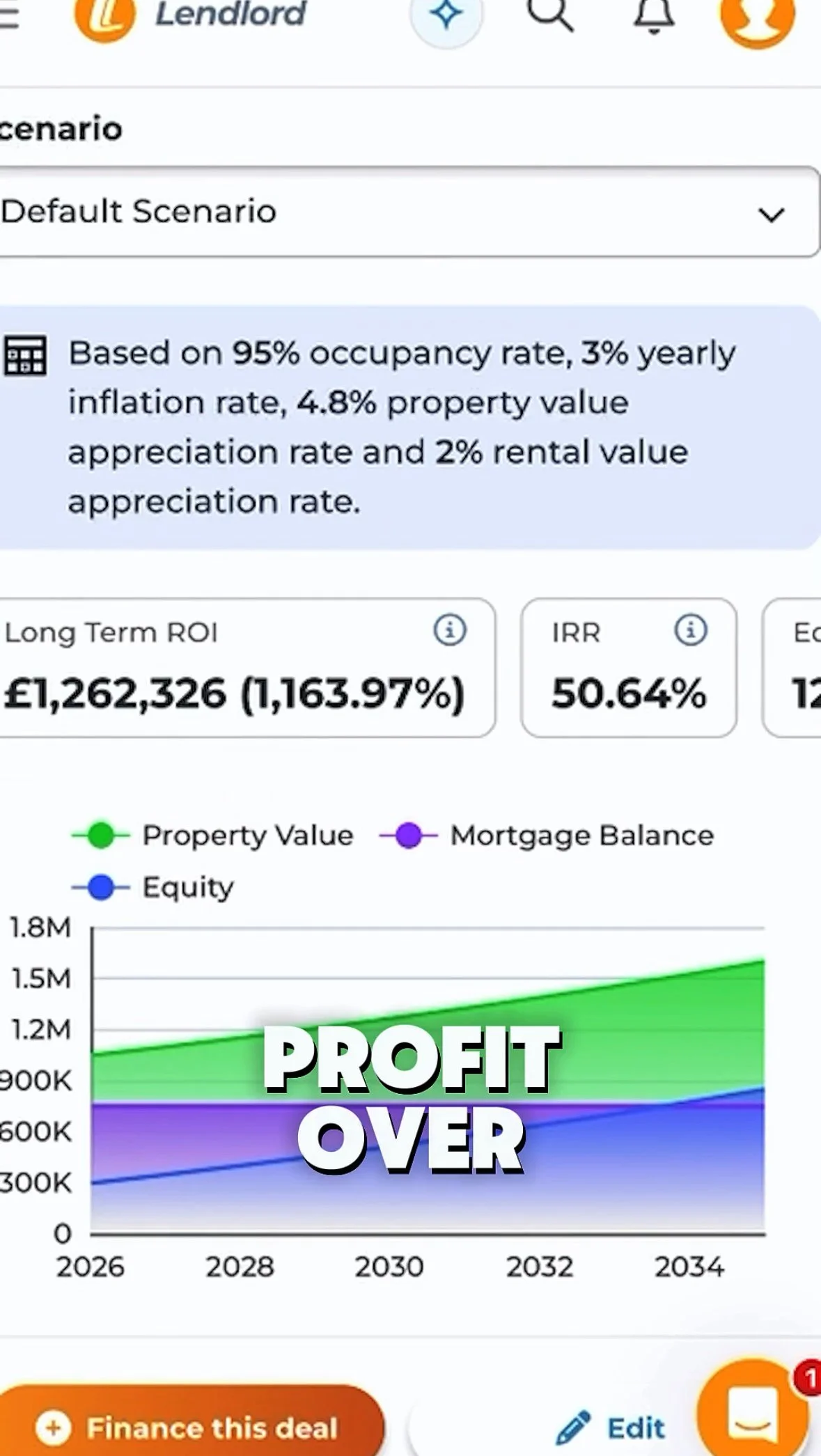
If I let that £50,000 sit in a fund or used it for a vanilla buy-to-let, I’d be lucky to see 5–6% per year. Instead, we’ve mapped out a ten-year trajectory from that single outlay that’s heading toward £1 million in profit. That’s not theoretical. It’s already in motion.
Why the System Doesn’t Want You Thinking This Way
Let’s be blunt.
The government wants you small. The system wants you predictable. The financial institutions want you to buy at retail price and sit still while they skim your earnings via inflation and interest.
And the property “gurus”? Most of them are just parroting 2010 strategies that haven’t evolved with the market.
You have to go against the current to build real, enduring wealth in property today. That means:
Buying undervalued assets that others don’t understand.
Creating non-construction-based uplift.
Leveraging existing equity, not your personal savings.
And refusing to follow the outdated playbook of stacking low-yield lets and praying for capital growth.
That’s what I teach. That’s what I do. And that’s what works.
If you’re serious about doing things differently, not just louder, but smarter, start thinking in terms of Unicorn Properties, and start building momentum, not just a portfolio.
Because real wealth isn’t about owning more bricks. It’s about owning the right ones — and knowing how to unlock the gold hidden inside.

The £100K Mistake:
Every so often, someone wanders into the property space with sweeping statements like, “If you need bank debt, you shouldn’t be investing.”
Often, it’s a financial advisor. Sometimes, it’s someone with a trauma story from 2008. In this particular case, it was a sleep therapist named Alan, who apparently moonlights as an economist.
His view? If you don’t have the full cash to buy the property outright, you shouldn’t be playing the game.
That sounds safe. Conservative. Responsible, even. But when you break it down — not emotionally, but mathematically — you realise just how deeply flawed that advice is.
Why Buying Property in Cash Is Financially Illiterate.
Every so often, someone wanders into the property space with sweeping statements like, “If you need bank debt, you shouldn’t be investing.”
Often, it’s a financial advisor. Sometimes, it’s someone with a trauma story from 2008. In this particular case, it was a sleep therapist named Alan, who apparently moonlights as an economist.
His view? If you don’t have the full cash to buy the property outright, you shouldn’t be playing the game.
That sounds safe. Conservative. Responsible, even. But when you break it down — not emotionally, but mathematically — you realise just how deeply flawed that advice is.
Let me show you.
The Cash Buyer Illusion
Let’s say you have £100,000 to invest in property. You decide to take Alan’s advice and purchase a single property in cash for the full amount.
It rents for £10,000 per year, giving you a neat 10% yield.
No mortgage, no stress, no leverage. Just clean, slow growth.
Ten years pass. The property doubles in value, fairly reasonable if you’re in the right location and can ride the average UK growth curve. Your £100k asset is now worth £200k. You’ve also collected £100k in rent (ignoring inflation and expenses for simplicity).
Total gain: £200,000.
You’ve effectively doubled your money over a decade. That sounds fine… until you realise what you've left on the table.
The Leverage Advantage
Now let’s look at what happens if you take the same £100k and apply strategic leverage.
Instead of buying one property outright, you split the capital into four £25k deposits and secure 75% mortgages on each. Now you own four properties, each worth £100k, controlling a £400k portfolio with just your £100k invested.
Each unit still rents for £10,000 per year — but this time, you’re paying £5,000 in mortgage interest per property. That gives you £5,000 net cashflow per unit, or £20,000 per year total.
Already, your cashflow return is 20%, double that of the debt-free model. But we’re not done.
The Long-Term Growth Picture
Fast forward ten years. Each £100k property has doubled to £200k.
The unleveraged investor now owns one property worth £200k.
The leveraged investor owns four properties worth £800k in total.
Let’s break down the equity picture:
You still owe £75k per property, or £300k in total.
But the market value is now £800k.
That means you’ve grown your equity position from £100k to £500k a £400,000 gain. That’s four times the capital growth of the cash-only investor.
And all of this assumes you never re-leverage, never refinance, never reinvest rental profits, just hold and wait.
Inflation: The Unseen Ally
Here’s what Alan and the cash-is-king crowd don’t understand:
Inflation punishes cash and rewards debt.
Your £300,000 mortgage doesn’t grow with inflation. But rents and property values do. Over time, your debt gets smaller in real terms, while your income and asset values rise.
In a high-inflation environment — like we’ve seen across 2022–2024 — that difference becomes even more pronounced. You're essentially paying off fixed debt with inflated pounds, while enjoying rental increases that track real-world costs.
This is how banks, institutions, and seasoned investors stay ahead.
It’s how wealth is transferred, not by avoiding debt, but by understanding how to use it intelligently.
The Cost of Playing Safe
Let’s recap the two scenarios over ten years:
Strategy Rent Collected Capital Gain Total Return
Cash Buyer £100,000 £100,000 £200,000
Leveraged £200,000 £400,000 £600,000
Same starting capital. Same properties. Same market.
£400,000 difference in outcome, purely from using leverage.
So let’s be clear: buying in cash is not “safe.”
It’s lazy capital allocation. It’s financial underperformance masked as caution.
It’s the kind of advice that might help you sleep at night… but it’ll cost you dearly in the morning.
What the Gurus and the Government Won’t Say
There’s a broader conversation here.
The system wants you to fear debt. They don’t teach strategic leverage in schools, and they certainly don’t encourage it in mainstream financial planning.
Why?
Because the system isn’t designed to produce investors. It’s designed to produce savers, predictable, risk-averse, inflation-eroded savers who will be sold financial products their entire life.
Debt, when used correctly, isn’t a burden. It’s the engine that drives real asset accumulation.
The problem isn’t leverage. It’s ignorance.
Final Thought: Choose the Right Game
This isn’t just about numbers. It’s about choosing a different financial model, one where you use bank money to control appreciating assets, grow cashflow, and build wealth that isn’t eroded by inflation or taxed by inaction.
You don’t need to be reckless to use leverage.
You just need to be educated, precise, and strategic.
That’s the world we operate in.
That’s the playbook I follow.
And it’s why (while Alan the sleep therapist is waiting for his pension) we’re building real wealth from real assets.
If you’re ready to stop playing small, and start using capital the way professionals do, I’ve got the frameworks and case studies to help you do it properly.
— Rob

The 5 Families of Property Finance:
If you want to scale a property portfolio in today’s market, you need to stop thinking like a borrower and start thinking like a capital allocator.
Most investors rely on one type of funding — usually a high street mortgage — and hope that if they wait long enough or buy enough units, they’ll reach financial freedom.
But in 2025, with higher interest rates, tighter lending criteria, and increasing scrutiny on landlords, that “one-lane” model is outdated. If you want to scale without hitting a wall, you need to understand — and use — the five core families of property funding.
These aren’t tricks. They’re the strategic foundations of how professionals structure and fund their portfolios. Learn them, and you’ll never be stuck waiting on a lender or capital partner again.
If you want to scale a property portfolio in 2025, you can’t think like a borrower anymore. You need to think like a capital allocator.
Most landlords never get that far. They learn one tool — usually a high street buy-to-let mortgage — and then bash it against every problem they face. Eventually, they hit the inevitable wall: stricter lending criteria, affordability stress tests, or a bank that simply says “computer says no.”
That’s when the frustration kicks in. They think they’ve “run out of money” or “run out of borrowing capacity.” The truth? They’ve only run out of imagination.
Professional investors don’t rely on one tool. They build with a full arsenal. And when you zoom out, every creative structure, every “hack” you’ve ever heard about in property, falls into one of five core families of finance.
Learn them properly and you’ll never again be stuck waiting for a lender’s permission slip.
Why the Old One-Lane Model Is Broken
In 2010, you could scale a portfolio with little more than persistence and a clean credit file. Rates were cheap, underwriting was softer, and the game rewarded volume. If you just kept buying, eventually you’d get rich.
That world is gone.
Interest rates are higher. Cheap debt isn’t a given anymore. Every percentage point in the Bank of England base rate changes affordability.
Stress tests are tighter. Many lenders now require rent to cover 145–170% of mortgage payments at notional interest rates of 5–7%. That rules out deals that used to slide through.
Scrutiny is heavier. Landlords are treated like businesses now, not hobbyists. Your track record, tax structure, and compliance all affect whether you get a “yes.”
If you only know how to work the high street, you’re boxed in. To scale, you need flexibility. That’s where the five families come in.
Family 1: Traditional Debt
This is the foundation. Mortgages and bridging loans are still the cheapest capital in the market. If your deal ticks the boxes, this should always be your first port of call.
Loan-to-value (LTV): Typically 60–80%.
Rates: Lower than any other funding source (because banks have the lowest cost of capital).
When to use: Standard properties, strong rental cover, clean borrower profile.
Example: You buy a £200K single-let in Manchester. Deposit £50K, mortgage £150K at 5.5%. Rent of £1,000/month covers the loan with margin. Traditional debt works beautifully here.
The professional edge: Use traditional debt whenever it’s available — but don’t build a strategy that depends solely on it. Because eventually, you’ll get capped by income multiples, portfolio limits, or valuation constraints. That’s when amateurs stall and professionals pivot.
Family 2: Joint Venture (JV) Equity
JVs are the power of alignment. You bring the deal and the execution. Your partner brings the capital. You share the profits — often 50/50.
Use it when: You’ve got strong deal flow but lack liquidity.
Why it works: Removes deposit constraints, allows you to operate faster and at bigger scale.
The trade-off: You split the upside.
Example: You find a block conversion requiring £500K. You’ve got the deal and the contractor team, but not the capital. A JV partner puts in the money. You manage the project. At sale, profits are split evenly.
The professional edge: JVs are high-trust capital. They only work if expectations are clear from day one: how profits are split, how risks are shared, and how decisions are made. The worst JV isn’t when you lose money — it’s when you fall out.
Family 3: Private Notes
Private notes are direct lending arrangements with individuals. They lend you money at fixed returns (8–12% is common) secured against the property or project.
Use it when: You need speed or flexibility.
Why it works: No equity split, less bureaucracy than banks, and you keep the upside.
The trade-off: Higher cost of capital.
Example: A motivated seller wants to complete in 28 days. A bank can’t move that fast. You borrow £100K from a private investor at 10% interest for six months, secured against the property. The deal completes. Later, you refinance with a bank and repay the note.
The professional edge: Private notes are the grease that lets you move when banks stall. Professionals cultivate a network of private lenders precisely so they can strike fast.
Family 4: Asset-Backed Credit Lines
This is where your existing portfolio becomes your liquidity engine. Instead of letting equity sit idle, you unlock it.
Use it when: You’ve built equity in properties and want to recycle it into new deals.
Why it works: It’s revolving. Draw down in days, repay, reuse.
The trade-off: Interest rates can be higher than term loans, and lenders cap against conservative valuations.
Example: You own 10 properties with £1m equity. Instead of refinancing each, you arrange a £500K credit line secured against the portfolio. Now you can fund multiple acquisitions on your own timeline without new mortgage applications.
The professional edge: Asset-backed facilities are how big players scale. They don’t wait six months for every refinance. They keep a war chest.
Family 5: Vendor Finance
This is the most overlooked — and one of the most powerful. Vendor finance means the seller helps fund the purchase.
Use it when: The seller is motivated by certainty, speed, or tax deferral more than immediate cash.
Why it works: Zero-down entry. You control the asset without needing a bank, a JV partner, or a deposit.
The trade-off: Not every seller will agree. You need to find the right circumstances.
Example: A landlord is retiring with a £1m portfolio. They don’t want to crystallise a massive tax bill in one go. They agree to sell you the portfolio on terms: you pay 20% now, and the balance over five years, with interest. You grow your portfolio without traditional finance.
The professional edge: Vendor finance requires creativity and trust. It’s not advertised on Rightmove. But with the right seller, it’s the ultimate way to scale without limits.
Why Professionals Use All Five
Here’s the mindset shift:
Amateurs ask, “Can I afford it?”
Professionals ask, “What’s the right capital structure for this deal?”
That’s the difference. It’s not about whether you personally have the money. It’s about structuring each opportunity with the optimal mix of capital sources.
One deal might be 70% bank debt, 20% private note, 10% your own cash. Another might be a JV with zero debt. Another might be pure vendor finance.
The point is: you’re never stuck. When you understand the five families, you always have a way forward.
The Trade-Offs: Cost vs Control
Every funding family has its price.
Traditional debt: Cheap, but slow and conservative.
JV equity: Fast, but you give away upside.
Private notes: Flexible, but expensive.
Asset-backed lines: Efficient, but only if you already own assets.
Vendor finance: Creative, but rare.
Professionals don’t avoid these trade-offs. They manage them deliberately.
The Bigger Picture: From Borrower to Allocator
The average landlord is a borrower. They see banks as gatekeepers, and their growth stops when the bank stops.
The professional investor is a capital allocator. They treat money like a toolkit. Each tool has a purpose, and they pick the right one for the job.
That’s why professionals scale portfolios into the hundreds of units while amateurs stall at three.
Final Thought
If you want to play this game seriously, stop asking, “How do I get another mortgage?” and start asking, “Which capital family unlocks this deal?”
Because the future of property isn’t about begging for bank approval. It’s about structuring capital intelligently.
That’s how professionals fund deals without limits.
If you want a real breakdown of how these strategies are used in the field — with case studies, templates, and negotiation tactics — I’ve written it all down in a short, sharp book called Property Unicorn.
And right now, you can get a copy free.

Why You’re Losing £100,000s on Property Deals, And What to Do Instead.
Every week, I meet well-meaning investors — many of them first-time landlords or early-stage buyers — who proudly tell me they’ve secured a couple of shiny new flats off-plan in a so-called “hotspot.” They show me brochures, cite forecasted growth percentages from regional reports, and wait for applause.
But here’s the brutal truth:
Most traditional buy-to-let investors are throwing away hundreds of thousands of pounds over the next decade — all because they’re investing the wrong way.
It’s not because they’re lazy or reckless. It’s because the model they’re following is fundamentally flawed. It’s built on assumptions that no longer hold true in the current market.
The UK property market is full of smart people doing dumb things with good intentions.
Every week, I meet well-meaning investors, many of them first-time landlords or early-stage buyers, who proudly tell me they’ve secured a couple of shiny new flats off-plan in a so-called “hotspot.” They show me brochures, cite forecasted growth percentages from regional reports, and wait for applause.
But here’s the brutal truth:
Most traditional buy-to-let investors are throwing away hundreds of thousands of pounds over the next decade, all because they’re investing the wrong way.
It’s not because they’re lazy or reckless. It’s because the model they’re following is fundamentally flawed. It’s built on assumptions that no longer hold true in the current market.
Let’s unpack this, and more importantly, let me show you a better way.
The Standard Buy-to-Let Blueprint (And Why It’s Broken)
Let’s say you have £100,000 to invest in property, a typical figure for many first-time investors, family landlords, or people cashing in a pension lump sum.
The advice they’re often given is simple:
“Put down 25% deposits on a couple of new-build flats in a regeneration area. Let them out. Hold for capital growth.”
Sounds solid. Let’s run the numbers.
Take this real listing in the North West — a region heavily marketed for “growth potential”:
Price: £200,000 per unit
Deposit (25%): £50,000
Plus SDLT, legal fees, mortgage setup, furnishing, etc.: ~£16,500
Total cash required for two units: ~£133,000
So far, so typical.
Now, what do these flats return?
Gross Rent per unit: ~£10,000/year
Mortgage interest: ~£5,000/year
Net profit per flat (before tax, voids, and maintenance): ~£5,000
Total net return on capital: £10,000/year or ~7.5% gross / ~2.15% net yield on cash invested
And this is best-case scenario before tax and assuming no repairs or voids.
Here’s the kicker: investors are told that a 28.8% growth forecast over the next 5 years will make this model work.
But this thinking is backwards.
Why?
Because they’ve paid full market (or developer-inflated) price. If the value does rise 30% over 5 years, that simply brings them back to true market value, not ahead of it.
They’re not banking profits. They’re just clawing back the premium they overpaid in the first place.
A Better Model: Create Value, Don’t Wait for It
Let’s take the exact same cash, £133,000 and apply a different model.
In 2023, I purchased a tired mixed-use building for £345,000. It wasn’t flashy. It wasn’t off-plan. But it had something far more valuable:

➡️ Undervalued income potential.
We spent around £75,000 on light cosmetic upgrades. Nothing structural. No planning permission. No new build complications. Just:
White-boxing the retail unit to make it lettable
Re-engineering the tenancy structure for efficiency
Modernising the internals with simple layout tweaks

Within 18 months:
The building was independently valued at £750,000+
It now generates £5,000+ per month in rent
We used open-market bridging finance to buy and refurbish
On refinance, the new valuation allowed us to pull out our original £133,000, plus an additional £100,000 in working capital
That’s £233,000 in the bank, a cashflowing asset, and none of our original money left in the deal.
Let’s compare that to the two off-plan flats.

The Hidden Problem With “Safe” Investments
Off-plan and turnkey buy-to-lets are marketed as “hands-off,” “low-risk,” and “guaranteed growth.”
But let’s be honest, when a developer offers a guaranteed rent, it’s not a gift. It’s priced into the sale. And when you buy something brand new, you’re not buying value, you’re buying someone else’s margin.
Here’s the uncomfortable truth:
You are the exit strategy for someone else’s value-add model.
They bought the land cheap, got planning uplift, built at scale, added margin, and now sell to retail investors who believe they’re securing “growth.”
By contrast, the Unicorn Model I use is about finding assets that are:
Undervalued at purchase
Capable of income or layout re-engineering
Able to refinance based on real, forced uplift, not speculation
This allows you to get your capital back fast, and then reuse it, again and again.
The Real Power of Rinse-and-Repeat
After refinancing that first deal, we used the surplus capital to buy a block of seven flats.
That block now rents for over £100,000 per year. The cash pot that was tied up in two underperforming flats in the mainstream model now controls:
A cashflowing mixed-use asset
A block of 7 residential units
A combined income stream over £130,000/year
Equity growth from two assets
That’s the difference between buying like a landlord and thinking like a developer.
And we did it all with the same original £133,000 that would’ve gone into two off-plan boxes.
Let’s Talk Compounding
The final point most investors miss is this: compounding only works when your capital can move.
When your cash is locked in a deal, even a good one, it’s not compounding. It’s stagnating.
By extracting your capital through refinance, you keep your capital in motion, and that’s when compounding kicks in.
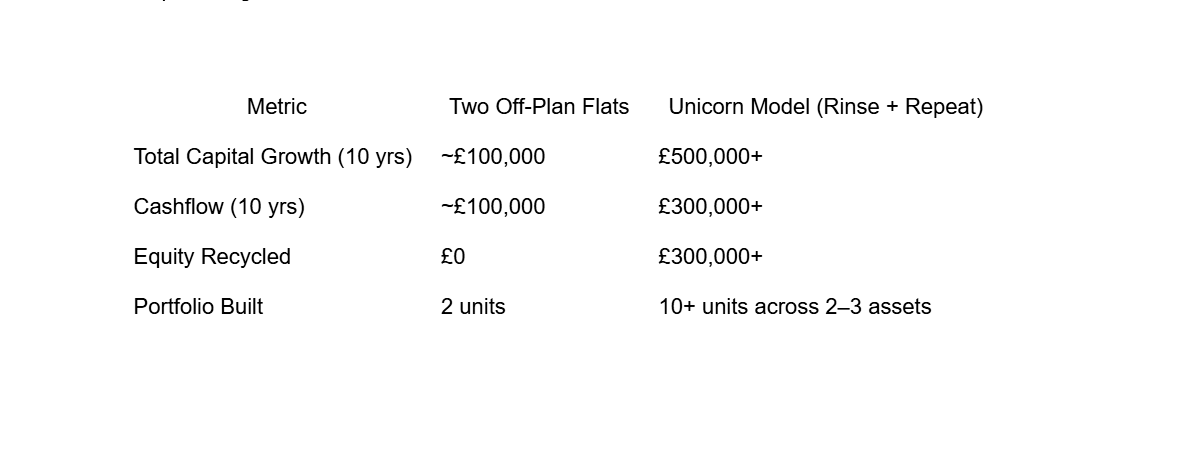
Let’s compare the 10-year outlook of the two models, assuming just 4% annual growth (far below the 28.8% some are sold on):
Final Word: Don’t Buy Property. Engineer It.
Stop buying what’s being sold to you.
Stop waiting for growth to save a poor decision.
Stop assuming that “property always goes up” is a strategy.
What worked for landlords in 2005 does not work in 2025.
The gap between high-street investor and high-performing operator is widening. You either learn how to play like a pro,or you become someone else’s exit.
The good news?
This model isn’t a secret.
It’s not a gimmick.
It’s not reserved for developers in suits with six-figure bank accounts.
It’s systemised, repeatable, and fully explained in my book, Property Unicorn.
📘 Want the full step-by-step playbook?
I’ll send you a free copy of the book. Just hit the link and request it. No charge — just the system we use, backed by real numbers, that works in today’s market.
Stop hoping. Start engineering.
— Rob

5 Creative Finance Hacks You Won’t Hear From the Property Gurus
5 Creative Finance Hacks You Won’t Hear From the Property Gurus
Let’s be honest — most people teaching property today are stuck in the 2010s.
They’re still banging the drum about buy-to-lets, flipping for crumbs, or trying to squeeze ROI out of overpriced terraces with vanilla mortgages. Meanwhile, the reality of 2025 looks very different: tighter credit, higher rates, slower market movement — and a need for smarter, faster, more flexible finance.
That’s where creative finance comes in.
Let’s be honest, most people teaching property today are stuck in the 2010s.
They’re still banging the drum about buy-to-lets, flipping for crumbs, or trying to squeeze ROI out of overpriced terraces with vanilla mortgages. Meanwhile, the reality of 2025 looks very different: tighter credit, higher rates, slower market movement, and a need for smarter, faster, more flexible finance.
That’s where creative finance comes in.
Not as a workaround for people with “no money”, that’s guru bait. No, these strategies are for real investors who want to scale quickly, ethically, and efficiently without being bottlenecked by deposit requirements or debt ceilings.
Here are five proven creative finance tools I teach inside my Property Unicorn program, not theory, but strategies I use in real deals, with real numbers, right now.
1. Lease Option Agreements
Control now, own later, without debt or JV headaches.
The concept is simple, but devastatingly effective: you lease a property today, and secure the right (not the obligation) to buy it at a fixed price in the future. It’s essentially a “delayed completion” deal with upside protection baked in.
✅ Why it works:
You benefit from market appreciation, rental income, and capital uplift without needing a mortgage or deposit up front. No legal title means minimal friction, but full control over cashflow and value.
Who it works for:
Sellers with stalled listings, tired landlords, or developers with surplus stock often prefer this over waiting for a sluggish buyer market.
The deeper strategy:
You can add value during the lease term, change the use, secure planning, or reconfigure layouts, before you ever buy the building. That’s value-creation without capital exposure.
2. Balance Sheet Hacking
Acquire the company, not the property.
This is one of the most underused, and misunderstood, strategies in UK property. Rather than buying the asset, you buy the Ltd company that already owns it. In doing so, you step into their balance sheet, their existing mortgage, and sometimes even their contracts.
✅ Why it works:
You avoid mortgage reapplication, valuation delays, and often save on SDLT (because you're buying shares, not bricks). You inherit existing terms, which can be a game-changer if the original finance was favourable.
The catch:
You must forensically audit the company accounts. This isn’t a trick, it’s a legitimate M&A strategy used by corporate investors for decades. But you need solid legal and financial oversight to do it safely.
The deeper benefit:
This lets you scale faster than your personal debt capacity allows. It’s institutional thinking, applied by nimble operators.
3. 100% Bridging on Open Market Value
Finance the full value, not just the purchase price.
Most investors use bridging for speed, but they forget its greatest strength is in asset-backed lending. If a deal is genuinely undervalued, some lenders will bridge against the full open market value, not just what you're paying.
✅ Why it works:
If you’re buying for £300K and the property’s worth £400K on a valuer’s report, you can borrow the full purchase price, zero money down. This lets you move quickly, secure rare deals, and recycle capital with minimal friction.
Key point:
This only works when the deal is demonstrably below market value, so your ability to source and negotiate well is everything.
Hidden bonus:
Once you control the asset, refinance onto a lower-rate term product, and you’ve created instant equity — and set yourself up for long-term cashflow with no dilution.
4. Vendor Deposit Deferment
Pay the deposit from future profits.
Sometimes, the simplest thing is to just ask the vendor to wait.
If the deal is right — and you’ve shown credibility — you can structure an agreement where the seller defers all or part of your deposit until income starts rolling in. You complete the transaction but pay the balance after a set term.
✅ Why it works:
Most people assume deposits must come from savings or investors. But if you offer the seller certainty and speed, they’ll often trade for delayed payment — especially if they’re not under time pressure.
When it works best:
On off-market deals, tired portfolios, or commercial-to-resi conversions where the vendor sees the long-game.
The real play:
Use the rent to pay the deposit, and you’ve effectively created a zero-cash-flow-to-control transition. That’s how smart investors scale without waiting on capital.
5. Exchange Subject to Planning
Lock in today’s price. Add value before you even own it.
With this technique, you exchange contracts today, but only complete the purchase once you’ve secured planning permission, or whatever other milestone you agree on.
✅ Why it works:
You reduce risk by not committing to the full purchase unless value is guaranteed to increase. It’s perfect for deals where planning uplift, lease restructuring, or permitted development plays are on the table.
Use it strategically:
Negotiate a long completion window. Push value through during the delay. Then complete with equity already baked in, often with higher leverage options thanks to the improved GDV.
The nuance:
This method puts you in value-creator mode, not just buyer mode. And that’s where the real profits are made.
Final Thought: Don’t Follow the Crowd, Design the Game
Every single one of these strategies has helped me, and my students, unlock deals most investors walk past.
The difference?
We’re not playing the game the banks, the gurus, or the system want you to play. We’re designing our own rules, using leverage intelligently, controlling risk, and creating value before we commit capital.
This isn’t about “getting rich quick.” It’s about getting free from the traditional model, one deal at a time.
Let me know in the comments which of these you’ve used or want to learn more about.
And if you're serious about deploying Unicorn Momentum into your next deal, I’ve got the templates, scripts, and real-life examples waiting, just ask.
Until then:
Think less about how many properties you own.
And more about how creatively you control them.
— Rob

Bank Rate Stalled at 4.25%? How 6% Mortgages Let You Unlock £100k+ in Equity with Property Unicorns.
Yet now, Governor Andrew Bailey cautions that while the trajectory remains downward, “how far and how quickly” those cuts arrive is “shrouded in uncertainty.” His message is clear: inflation isn’t collapsing as hoped (it sat near 3.5% in April), wage pressures are still high, and global trade frictions linger.
Imagine it’s May 2025, and everyone thought the Bank of England would slice interest rates at least three more times this year, potentially as soon as its June meeting.
Market predictions of a sub-4 % base rate (with some even calling for 3.5% by the end of the year) seemed inevitable.
Yet now, Governor Andrew Bailey cautions that while the trajectory remains downward, “how far and how quickly” those cuts arrive is “shrouded in uncertainty.” His message is clear: inflation isn’t collapsing as hoped (it sat near 3.5% in April), wage pressures are still high, and global trade frictions linger.
In other words, a June cut may be pushed into August or later, and perhaps only a single 25-basis-point trim in 2025 rather than the two to three everyone expected.
That “pause” in rate cuts might feel like unwelcome news for would-be homebuyers hoping for cheaper mortgages. But if you’re the type who hunts mixed-use buildings — what I call “Property Unicorns” — this slower-than-expected path lights up an opportunity.
Why?
Because when borrowing costs stay elevated for a little longer, buyers who crave 3% mortgages hold off, sellers face a reality check on pricing, and smaller, hands-on investors like us can swoop in on underpriced deals without a stampede of big-money competition.
Think of a Property Unicorn as a modest block — four flats upstairs and a little shop or office downstairs — where you invest a relatively small sum (say £50,000) in smart refurbishments and lease negotiations. Within six months, those improvements push rental income up by 15–20%. A surveyor then looks at the higher rent roll and says, “This building is worth more,” effectively bumping the valuation by significantly more than the amount you spent.
You didn’t need to wait for mortgage rates to plunge; you engineered that value yourself, all while collecting £3,000 (or more) per month in net cashflow.
To see why this works so well in a “slow-cut” scenario, let’s rewind to earlier in 2025.
After trimming Bank Rate from 4.50 to 4.25% in May, most analysts thought a 4.00% rate was coming in June. Swap curves — those interest rates lenders use to price fixed-rate mortgages — dipped in late April and early May, teasing a broad easing.
But the April inflation print came in at 3.5% — higher than the BoE’s comfort zone — and wage growth in crucial sectors (healthcare, construction, logistics) remained sticky at nearly 5%. Combine that with fresh trade-policy uncertainty from U.S. tariffs and global supply-chain jitters, and Bailey felt compelled to dial back expectations. He’s publicly said the MPC wants to be “gradual and careful,” ensuring any future cuts don’t undo the fight against lingering inflation.
In practical terms, that means mortgage rates won’t tumble in June as once hoped. Instead, two-year fixed deals hover near 5.05%, five-year fixes around 5.15%. Back in 2021, those figures were often 1.50–2.00%.
So for a would-be buyer, £300,000 over 25 years at 5.15% equals roughly £1,800 per month. If the rate fell to 5.00%, payments only drop to around £1,750 — a mere £50 saving. Hardly a dramatic improvement, and not enough to spark a housing frenzy.
Bolstered by that realism, sellers who had priced homes and small shops assuming imminent 4.00% rates now reset expectations. If they want to transact in mid-2025, they must accept that high financing costs will remain part of the landscape. That, in turn, prompts some sellers to negotiate rather than hold out for a distant, hypothetical plunge to 3.50%.
In this environment, unicorn deals shine because you don’t hinge on broad market swings — you build value with your own hands.
Imagine spotting a block in Sheffield: four flats each renting for £7,500 per year, plus a ground-floor shop at £10,000, total income £40,000. The asking price is £420,000, implying a 9.5% yield.
At first glance, a 9.5% in May 2025 means serious rental upside, especially when comparable flats in the same area already achieve £9,000 to £9,500 per year. With a modest budget — say, £50,000 — you can modernise each flat (new kitchen, bathroom refresh, fresh paint) and spruce up the shop (new signage, minor façade work). That refurbishment takes about eight weeks.
Once complete, you re-let all four flats at £9,500 each — £38,000 in residential rent — then sign the shop to a new café operator at £13,000 per year. Your post-refurb rent roll jumps from £40,000 to £51,000 — an eye-popping 27.5% increase.
A surveyor, seeing that £51,000 in annual income, might apply a 7% capitalisation rate (a typical yield for a well-let, modernised mixed‐use block in a secondary city). At 7%, that rent roll suggests a value of about £730,000.
In reality, if you sell quickly, you might net offers around £700,000, leaving a small discount for a quick sale. Even so, you’ve taken £420,000 + £50,000 (= £480,000) in total commitment and turned it into an asset valued at over £700,000 in six months — an instant £220,000+ equity boost.
Meanwhile, finance costs remain high — if you borrowed 60% of £420,000 (≈£252,000) at a 6% interest-only rate, your annual interest is £15,120 (≈£1,260 per month). After letting expenses, insurance and maintenance (say about £10,000 per year), you clear roughly £25,880 per year — or about £2,156 a month.
When the BoE eventually cuts in August (or September if the data continues to frustrate), commercial mortgage rates might fall to ub 6%. That slight drop helps with refinance costs. You’d approach a lender in late 2025 with your newly proven rent roll: “Look, this building nets £25,000 per year after operating costs and interest at 6%; at 5.5% on a new valuation of £700,000, I can refinance 60% and extract roughly £420,000 of equity.”
You repay the old loan (£252,000), pocket about £168,000 in extracted equity, and roll that into your next Unicorn.
This means you now only have £50,000 of your original funds left in the deal, which is still producing a net income of £17,9000 (after £10k costs) per year — over 35% net return on capital employed.
By contrast, a traditional buy-to-let investor — putting down a 25% deposit on one £225,000 flat at 5% and getting 4.5% in rent — comes out roughly cashflow neutral. They wait for rates to fall lower, cross their fingers for capital growth, and hope that rental demand remains strong. In a “slow-cut” world, that investor is at the mercy of central banks. Your Unicorn strategy, however, locks in equity from strong rental improvements and your reserve of patience while markets wait for the next cut.
Another reason that slow cuts benefit Unicorn investors is psychological: when cuts are fast and steep, buyers rush in, driving prices above their fundamental value. We observed that in 2021–2022, two-year fixed rates reached around 1.5–2%. Everyone bought, believing rates would stay low indefinitely, and prices soared 15–20% in many places. However, rates reversed quickly, prices stalled, and a correction ensued. With slow cuts, prices move more gently , perhaps just 2–3% later in 2025 and another 3–4% in 2026 , giving you breathing room. Sellers adjust to “5% mortgages are here,” and you can plan, negotiate, renovate, and refinance without the stress of a rapidly shifting market.
That “slow-cut” cushion also keeps vacancy rates low for rentals. Many folks who wanted to buy in May 2025 can’t afford a 5.15% mortgage, so they stay renting. Vacancy rates in strong university towns and commuter hubs remain near 2–3%. In turn, that tight rental market supports your ability to increase flat rents by 20% post-refurb — never a given, but far likelier when demand outstrips supply. On the commercial side, small shops and cafés that might struggle in a booming city centre find a captive audience in a residential block. When you present a freshly updated café or convenience store with solid tenant reference, landlords and lenders view that as a stable income stream. That further bolsters your refinancing pitch.
In a nutshell, the slower-than-expected rate cuts set up a rare window of opportunity. Sellers, who once believed they could fetch top prices if mortgages dipped to 4%, now face the reality of 6% rates persisting. They adjust pricing accordingly, giving us hands-on investors better deals. Big funds, which chase very cheap debt to make slim yields work, hold back, leaving mixed-use blocks to local players.
Meanwhile, rental markets remain firm, commercial mortgage rates are expected to hold at around 6% until at least August, and surveyors continue to value strong rent rolls at reasonable yields (7–8% for updated mixed-use properties). All of this converges to create an ideal environment for Property Unicorns: you can buy at high yields (9–10%), invest £40,000–£50,000 to drive yields down to 7%, and capture that spread in equity.
It’s important to emphasise: you’re not “betting” on rates falling dramatically. Instead, you’re banking on your expertise — finding under-priced blocks, negotiating favourable purchase prices, managing innovative renovations, and securing long-term leases. Even if the BoE delays further cuts until October or November, you still capture most of your uplift through operational improvements. When banks finally do offer a slightly improved refinance rate — say, 5.5 %— you pocket that incremental advantage on top of your expertly generated equity.
People often ask, “Isn’t it too risky to buy a small mixed-use building when rates are still high?” The answer is that risk is relative. A standard buy-to-let flat at 4% yield — when you’re borrowing at 5%— leaves you vulnerable. You might be cash flow neutral or slightly negative until rates fall by two whole points. With a Unicorn, you start at a 9–10% yield. You know exactly how much rent you’ll achieve after renovation. You forecast refinancing at 5.5% per cent. You build in a safety buffer , covering one or two months of void via reserves. And fundamentally, you’re not speculating on Brexit shocks or pandemic rolls, but on concrete on-the-ground improvements: new kitchens, fresh bathrooms, better tenant quality. That level of control makes your risk profile quite manageable.
Looking ahead to late 2025 and early 2026, once inflation drifts further toward 2.5 per cent and wage growth eases, the BoE is likely to trim the Bank Rate to 4.00 per cent in August and 3.75 per cent by early 2026. That may nudge five-year resi fixes down to near 4.75–4.90 per cent — certainly better than today’s 5.15 per cent. Commercial mortgages should follow suit.
By then, you will already have executed your Unicorn strategy: bought, renovated, re-let, and either sold or refinanced. So you capture both your hands-on value creation and any remaining yield compression. Meanwhile, house prices might creep up only 2–3 percent in late 2025 and 3–4 per cent in 2026 — hardly a blistering boom, but enough that your long-term hold has further upside beyond your immediate equity gain.
In short, May 2025’s “shrouded path” of rate cuts is not a deterrent — it’s a clarion call. When everyone else waits for a perfectly timed decline, you, the Property Unicorn hunter, move on the deals that exist now. You negotiate while big funds twiddle their thumbs. You create equity when sellers reluctantly accept that 5 per cent mortgages are here to stay. And you refinance at a slightly better rate when the BoE eventually bends — pocketing a tidy profit and steady cashflow along the way.
If this resonates and you want the full, step-by-step playbook — detailed case studies, budgeting templates, negotiating scripts, refurbishment checklists, refinance strategies — grab a copy of Property Unicorns.
Inside, you’ll learn exactly how to turn uncertainty into opportunity, build your equity ladder one block at a time, and thrive, even when the Bank of England’s path remains uncertain. When a rate cut finally arrives, you won’t be scrambling for a deal — you’ll already be on to the next Unicorn.
Just click here now to order your free copy, you just need to cover the £4.97 P&P!

The Broken uk planning system
It all begins wiTake a look at the biggest UK homebuilders — Barratt, Persimmon, Taylor Wimpey, Bellway. These aren’t just property companies; they’re controlled by major institutional investors like BlackRock. Planning laws aren’t about ensuring fair competition; they’re about maintaining the monopoly of big players.
When the government claims to be supporting property development, what they’re really doing is:
Fast-tracking large-scale projects that benefit institutional investors.
Leaving small and mid-sized developers trapped in bureaucracy.
Creating artificial supply shortages to inflate property values.
So, where does that leave us? If you’re a property entrepreneur trying to build a portfolio, create housing solutions, and contribute to the market, you have two choices:
Accept the system is broken and give up.
Adapt, innovate, and disrupt using the Unicorn Model.th an idea.

image from building.co.uk
For years, the UK government has promised to fix the planning system to accelerate economic growth, support development, and address the housing crisis. Yet, here we are — dealing with a fundamentally broken system that stifles innovation, pushes small developers to the side-lines, and hands power to large corporations.
I’m not just another property commentator. I live and breathe this business. I’ve built a successful career by disrupting the status quo and finding solutions where others see roadblocks. Today, I want to talk about how the UK planning system is failing us, who benefits from its dysfunction, and — most importantly — how small developers can still win using my Unicorn Model.
The UK Planning System: A System Designed to Fail.
The UK planning system isn’t just slow — it’s designed in a way that actively prevents small developers from succeeding. I have a project that should have made £200,000 in profit, yet it’s been stuck in planning for nine months. Why? Because of a sudden “planning lockdown” imposed due to phosphate pollution in a river 30 miles away. That’s right — red tape from an unrelated environmental issue has frozen a legitimate, well-planned investment.
And I’m not alone. Across the UK, thousands of developments are stalled due to bureaucratic inefficiency, shifting regulations, and council backlogs. The result?
A severe shortage of rental properties that drives up rents.
Small developers forced out of the market, leaving only the big players.
A government promise to build 1.5 million homes that is nothing more than a fantasy.
Let’s be clear: the current planning system doesn’t work for entrepreneurs like us. It works for large corporations, who have the resources, political influence, and patience to play the long game.

Who Really Benefits?
Take a look at the biggest UK homebuilders — Barratt, Persimmon, Taylor Wimpey, Bellway. These aren’t just property companies; they’re controlled by major institutional investors like BlackRock. Planning laws aren’t about ensuring fair competition; they’re about maintaining the monopoly of big players.
When the government claims to be supporting property development, what they’re really doing is:
Fast-tracking large-scale projects that benefit institutional investors.
Leaving small and mid-sized developers trapped in bureaucracy.
Creating artificial supply shortages to inflate property values.
So, where does that leave us? If you’re a property entrepreneur trying to build a portfolio, create housing solutions, and contribute to the market, you have two choices:
Accept the system is broken and give up.
Adapt, innovate, and disrupt using the Unicorn Model.
The Unicorn Model: How to Win Despite the Bureaucracy.
I’ve built my success by going where others won’t go and creating strategies that bypass obstacles. That’s where my Unicorn Model comes in.
The Unicorn Model is simple: Don’t rely on the system — build your own path.
1. Multiple Exit Strategies: Play the Long Game.
One of the biggest mistakes developers make is relying on a single outcome. The planning process is unpredictable — you need multiple ways to extract value from your investments.
For my Wrexham project, instead of sitting around waiting for planning approval, I’ve created two backup strategies:
Option 1: The “Costco Method” — Repurpose the building into individual commercial units. Retail space, office rentals, and storage solutions can generate steady cash flow.
Option 2: Lease and Hold — Instead of waiting for planning, secure a tenant on a long-term lease, generating income while planning resolves itself.
Too many developers put themselves in a single-outcome trap — that’s a mistake. Always plan for multiple exits.
2. Unlock Hidden Value: Think Like a Disruptor.
Traditional developers follow the herd. Disruptors find what others overlook.
Instead of fighting over prime locations, start looking at:
Secondary cities and commuter towns where demand is rising.
Mixed-use properties that give flexibility in strategy.
Underutilized commercial spaces that can be repurposed for high-yield housing.
Planning laws make it harder for small developers to get projects approved — but there are still opportunities if you know where to look.
3. Build Trust, Not Bureaucracy.
The system doesn’t work in your favour — so stop relying on it. Instead, create your own network of trust:
Local Councils & Communities — Engage early, build relationships, and become the “go-to” developer who solves problems.
Private Investors — Don’t wait for bank funding. Build a network of investors who see the long-term vision.
Planning Consultants & Legal Experts — The right advisors can help you navigate roadblocks faster than going it alone.
When you position yourself as a leader in the space, you’ll find more doors opening — even in a system designed to close them.
4. Control Your Narrative: Be the Authority.
The biggest property developers in the UK don’t just build properties — they control the conversation.
You need to do the same. That means:
Publishing your expertise (like I’m doing now).
Leveraging media and PR to highlight how broken the system is and why your solutions work.
Educating your audience — investors, tenants, councils — so they see you as the trusted voice in property development.
If you don’t tell your story, someone else will — on their terms.
The Future of Property Development Belongs to the Disruptors.
The UK planning system isn’t going to change overnight. The big players want it this way. But here’s the truth:
The housing crisis is real. Demand for property is skyrocketing.
The rental market is tightening. Rents are rising as supply shrinks.
People need solutions. And governments don’t build houses — entrepreneurs like us do.
The future of property does not belong to those who follow the rules blindly. It belongs to those who find new ways to win.
I’m not waiting for the system to fix itself. I’m finding the gaps, the opportunities, and the strategies that allow me — and my investors — to thrive despite the chaos.
Are you ready to do the same?
🚀 Take Action Now
If this resonates with you, let’s connect. I’m actively working with investors, developers, and disruptors who refuse to accept the status quo. The opportunities are there — you just need the right mindset and the right model to seize them.
And if you’re looking to understand how to invest in the new world of property entrepreneurship, I’ve put together a free and on demand training for you.

The Landlord Myth: Reframing the Housing Crisis.
In the emotionally charged debate surrounding the UK housing crisis, landlords are often painted with a broad brush — as profiteering villains capitalising on basic human needs. This narrative is not only misleading, but dangerously reductive. If we are serious about tackling housing affordability, we must first engage in a more nuanced and evidence-based conversation.
In the emotionally charged debate surrounding the UK housing crisis, landlords are often painted with a broad brush — as profiteering villains capitalising on basic human needs. This narrative is not only misleading, but dangerously reductive. If we are serious about tackling housing affordability, we must first engage in a more nuanced and evidence-based conversation.

This article is a call for clarity, critical thinking, and a recalibration of blame. As a property professional, I’ve witnessed first-hand how systemic dysfunction — not individual greed — drives the issues we face. In this deep dive, I’ll explore the historical context, macroeconomic forces, policy failures, and demographic realities that shape today’s housing landscape — and why demonising landlords is a distraction from meaningful progress.
Shelter, Capitalism, and the Double Standard.
Shelter, alongside food, water, and warmth, is universally accepted as a fundamental human need. Yet landlords are held to a different moral standard than those who provide our other necessities. Nobody protests outside supermarkets for selling food at a profit. Energy companies may be scrutinised, but not categorically vilified. Why, then, is housing different?
This moral double standard stems from the emotional and symbolic weight that housing carries. A home is not just a commodity — it’s identity, security, family. When this ideal becomes inaccessible, emotions run high. But emotions should not dictate policy.
If we are to accept capitalism in other essentials, we must ask why we selectively reject it in housing. And if we truly wish to remove profit from shelter, then we must envision and fund a viable public alternative — one that doesn’t yet exist at the scale needed.
Myth-busting: Are Landlords the Root Cause?
One of the most persistent arguments is that landlordism itself drives up prices. Critics claim that buy-to-let investors push up demand, reduce housing supply, and inflate both rents and property values.
At face value, this argument is seductive. But when held up to empirical scrutiny, it falters.
House Prices Follow Credit, Not Landlords: The most significant driver of house prices over the past 40 years has been the cost of borrowing. When interest rates fall, buyers can afford larger loans, pushing prices up. When rates rise, affordability drops and prices stagnate or decline. Blaming landlords without acknowledging this financial gravity is intellectually dishonest.
Landlords Are Diverse, Not Monolithic: The term “landlord” encompasses a vast spectrum. From retired couples renting a second property to full-time property entrepreneurs revitalising derelict buildings, the motivations and methods vary greatly. Treating all landlords as a single exploitative force ignores the economic reality and social contribution of many.
Landlords Exit, Prices Still Rise: Over the last decade, increased taxation and regulation have driven many landlords out of the sector. If landlordism alone caused price inflation, then their exit should have caused a drop. Instead, prices continued to climb, revealing the influence of deeper structural issues.
The Real Levers: Policy, Planning, and Demographics.
To truly understand the crisis, we must move beyond surface-level scapegoating and examine the underlying forces at play.
1. Planning System Paralysis
The UK’s planning system is notoriously slow, restrictive, and fragmented. Local opposition, bureaucratic inertia, and outdated zoning laws have choked new development for decades. Nimbyism thrives in a system that rewards obstruction over innovation. As a result, supply has failed to keep pace with population growth.
2. Macroeconomic Trends
Low global interest rates since the 1980s have fuelled asset bubbles around the world. Real estate, as a physical and appreciating asset, became a favoured store of wealth. Passive gains through property became the norm. This was not a landlord-specific phenomenon — it was a market-wide trend across homeowners and investors alike.
3. Immigration and Urbanisation
Net migration, particularly into major cities, has added substantial pressure to existing housing stock. The influx is not inherently negative — it fuels economic growth and cultural vibrancy — but it does require a proportional increase in housing, which has not occurred.
4. Government Incentives and Policy Failures
Schemes like Help to Buy have inadvertently driven up prices by stimulating demand without addressing supply. Meanwhile, tax changes (e.g., Section 24) and regulatory burdens have discouraged private sector participation without offering public alternatives.
Rents, Affordability, and Wage Dynamics.
A common media refrain is that rents are “skyrocketing.” And in nominal terms, this is often true. But nominal prices are only half the picture. The true measure of affordability is the rent-to-income ratio.
Interestingly, when wages rise quickly — as they have post-COVID — this ratio can improve, even as rents increase. Objective data shows that in many parts of England, rent affordability has actually improved, although it remains above comfortable thresholds.
Moreover, landlords face their own cost pressures:
Rising mortgage interest rates
Higher maintenance and materials costs
Increasing utility bills
Compliance costs from evolving regulations
When rents rise, it’s often a reflection of economic pressure — not opportunistic profiteering.
Four Faces of Landlordism.
To reject the caricature of the “greedy landlord,” we must recognise the diversity within the sector. Here are four landlord archetypes that reflect reality:
The Outlier Exploiters
Bad actors exist, just as in any industry. Their behaviour is reprehensible and should be stamped out. But they are the minority.
2. The Supplemental Pensioner
Many landlords are retirees using rental income to supplement pensions. They provide well-maintained homes and stable tenancies.
3. The Accidental Landlord
Individuals who’ve inherited property or moved without selling. Often emotionally invested in the homes they rent.
4. The Property Entrepreneur
Actively converts, renovates, and increases supply. These are the risk-takers revitalising derelict pubs, old shops, and vacant buildings — adding value to communities and supply to markets.
A Constructive Path Forward.
The housing crisis is real. But if we are to solve it, we must shift from blame to blueprint.
What we need:
Planning reform to fast-track housing developments
Incentives for converting empty buildings into housing
Public-private partnerships that blend state support with private initiative
Tax rationalisation to reward landlords who create or improve housing stock
Transparency and enforcement to root out rogue landlords without punishing the responsible majority
We must also promote nuanced public discourse — one that understands that systemic problems require systemic solutions.
Conclusion: Building, Not Blaming.
If housing affordability is our goal, blaming landlords will not get us there. It is a distraction that delays real reform. Let’s stop arguing about villains and start focusing on vision. Let’s champion those who invest in homes — not vilify them. Let’s build more homes, support those willing to take the risk, and hold the real levers of power — government, finance, and policy — to account.
The path forward is complex. But one thing is certain: simplistic narratives make for good headlines, but terrible housing policy.
It’s time to move past myths. It’s time to build.

The Death of Buy-to-Let and the Rise of Strategic Property Investing: A Critical Call for Reinvention
In the volatile tide of economic uncertainty, few markets have undergone such a swift and silent collapse as the UK’s traditional buy-to-let sector. The recent YouTube exposé “90% of UK Landlords Are About to Go Broke” is more than a sensationalist headline — it’s a wake-up call. As I dissect the insights presented in this video, one thing becomes starkly clear: we are witnessing the end of an era in property investing. But with that end comes opportunity.
In the volatile tide of economic uncertainty, few markets have undergone such a swift and silent collapse as the UK’s traditional buy-to-let sector. The recent YouTube exposé “90% of UK Landlords Are About to Go Broke” is more than a sensationalist headline — it’s a wake-up call. As I dissect the insights presented in this video, one thing becomes starkly clear: we are witnessing the end of an era in property investing. But with that end comes opportunity.
This article explores how outdated landlord models are crumbling under the weight of institutional policy shifts, macroeconomic pressure, and a rigged financial system. More importantly, it lays out a new blueprint for property investment — one that leverages adaptive intelligence, alternative asset structures, and high-cashflow innovations. If you’re a property investor, entrepreneur, or strategist, consider this your critical briefing.
The Slow Collapse of Buy-to-Let: A Strategic Post-Mortem
It’s easy to romanticize the golden days of buy-to-let. For decades, the formula was simple: purchase property, secure financing at record-low interest rates, watch asset values appreciate, and enjoy passive income.
But that world has vanished.
In its place, we find a landscape increasingly hostile to small-scale landlords. From 2016 onwards, UK government policy has chipped away at the foundations of private renting:
Section 24 removed landlords’ ability to offset mortgage interest against rental income.
Stamp duty surcharges increased acquisition costs.
Capital gains traps made divestment financially punitive.
Tenant rights reforms weakened operational control.
The culmination? A rapidly rising cost base, falling margins, and a shrinking pool of viable tenants. Mortgages have surged. Net profits have dwindled. And many landlords now find themselves stuck — unable to sell without major tax implications, but equally unable to sustain their leveraged positions.
This is not a cyclical dip. This is structural decay.
The Game Is Rigged — But You Can Still Win It
This is not just about a change of market dynamics, but of intentional economic architecture. Rather than random chaos, we are seeing a strategic dismantling of the private rental sector to make room for institutional control.
This isn’t conspiracy — it’s capitalism at scale.
Large real estate investment trusts (REITs), private equity funds, and pension-backed developers have long eyed the rental market as fertile ground. Unlike small landlords, they have:
Access to cheaper capital.
Political lobbying power.
Portfolio scale to absorb regulatory friction.
Patience to outlast short-term pain.
The rules of the game are being rewritten. But that doesn’t mean you should fold your cards. It means you need to play smarter.
If you want the playbook of how you can cash in on this market shift, order your free copy of my book, Property Unicorns (just cover the £4.97 P&P)
Data Doesn’t Lie: The Landlord Exodus Is Real
The government’s own landlord survey reveals an exodus accelerating at breakneck speed. Over six years, the number of landlords planning to decrease their portfolios has doubled, while those intending to expand sits at a mere 7%.
Most landlords are:
Individuals.
Retired or near retirement.
Holding a single rental property as a makeshift pension.
This demographic was never prepared for the kind of strategic adaptation required in today’s climate. As a result, many are fleeing the market, taking losses, or stuck in “zombie portfolios” — assets that neither generate cash flow nor can be sold.
In contrast, a new breed of investor is rising. These are operators, not speculators. Entrepreneurs who understand not just property — but systems, strategy, and structure.
The New Rules of Property Investment: Strategic Adaptation in 2025 and Beyond
So what replaces buy-to-let?
Here, the video presents a clear, actionable framework — the “New Rules” of property investment:
1. Profit Over Volume
Forget scaling through acquisition. This isn’t about adding more properties — it’s about extracting more value per property. That means targeting niche deals, underperforming assets, and inefficiencies you can correct quickly.
2. Cashflow is King
Single-lets are dead. The era of passive, yield-driven returns from single occupancy units is over. What replaces it? Multi-unit, mixed-use, serviced accommodation, and short-stay properties that generate robust monthly returns.
3. System Mastery
Banks and governments are optimizing for institutional players. You must understand how to navigate regulation, structure deals creatively, and avoid financial traps. The goal: build agility into your model.
Enter the “Property Unicorn”
Perhaps the most transformative concept introduced is that of the Property Unicorn — a high-yield, low-friction asset class that produces rapid value appreciation with minimal intervention.
These are not typical properties. They are multi-dimensional:
Mixed-use buildings with both residential and commercial units.
Guesthouses converted to apart-hotels.
Commercial spaces subdivided into mini-units.
Former retail locations converted via permitted development.
Key characteristics include:
Multiple income streams (residential + commercial + short-stay).
Paper-based value creation (i.e., title splitting, lease restructuring).
No planning permission required (via permitted development rights).
Seller-financed or creatively structured purchases (bypassing traditional banks).
These unicorns are rare — but they are scalable once you learn how to spot them.
Four Transformative Property Strategies That Actually Work
Here’s a breakdown of four real-world strategies to generate six-figure profits without major development work:

1. Urban Gold Mine (Mixed-Use Conversion)
A sweet spot between commercial and residential.
Bought for £345,000 from a retiring landlord.
Minor refurb plus a lease on the restaurant unit.
Now valued at £750,000.
Generates over £65,000/year net income from one asset.
Lesson: Leverage niche positioning and outdated owner knowledge.

2. The Costco Method (Subdivide Commercial)
Large commercial units are often underutilized and unattractive to small businesses. By splitting them, you:
Increase rental yield.
Create micro-tenancies with stronger demand.
Boost resale value through square-foot arbitrage.
Example: A building split and resold for almost double its purchase price with under £5K in works.

3. Apart-Hotel Model (Hospitality Conversion)
Post-COVID, many guesthouses and care homes are distressed assets. You can reconfigure them as:
Self-contained, high-density, short-stay units.
Airbnb and apart-hotel hybrids.
Long-term accommodation for digital nomads and professionals.
Example: A £760K care home set for revaluation at £2 million post-conversion.
4. Permitted Development Residential Conversion
Target commercial units that qualify for PD (Permitted Development) back to residential.
Avoids full planning.
Maintains cost efficiency.
Exploits price/sq.ft. arbitrage.
Example: £180/sq.ft purchase, £80 refurb, sold at £400+/sq.ft.

Why This Matters Now: The Strategic Investor’s Edge
Here’s the hard truth: if you’re still operating a property portfolio using pre-2016 strategies, you’re not just behind — you’re vulnerable.
But if you’re willing to shift your thinking, the opportunity is enormous.
This is a market ripe for specialist knowledge, creative structuring, and strategic agility. The institutions haven’t won yet. They’ve just raised the bar.
As independent investors, we must out-think, not out-spend.
Critical Thinking Questions for Investors
To build a resilient property business in today’s climate, ask yourself:
Am I relying on legacy assumptions?
About mortgages, tenants, cash flow, or tax policy?
Can I adapt to a mixed-use, multi-unit model?
If not, what skills or partnerships do I need?
How do I structure deals beyond the bank?
Lease options, vendor finance, joint ventures?
What inefficiencies am I uniquely equipped to correct?
Speed, local knowledge, tenant experience, deal sourcing?
Final Thoughts: Reinvention as Authority
This is not about doom — it’s about empowerment.
“The difference between landlords who get wiped out and landlords who get rich is purely knowledge.”
This is your invitation to lead the conversation. To be a strategist — not a speculator. To position yourself as someone who understands not just what’s happening in property, but why — and what to do about it.
Thought leadership isn’t about having all the answers. It’s about asking the right questions, embracing uncomfortable truths, and leading others through the fog.
We’re entering a new era in real estate. You can either resist it — or reinvent yourself.
I know which one I’m choosing.
If you’d like to jump on my free webclass that walks you through the 6 steps to succeed in property in 2025, click here now.

How Global Turbulence Threatens the UK Property Entrepreneur, And How to Win Anyway.
It all begins with an ideIn a time where the only constant in the property market is change, small UK property investors are finding themselves fighting battles on multiple fronts. From stifling regulation to rising interest rates, and now a wave of global economic tremors triggered by Trump’s so-called “Liberation Day Tariffs,” the battlefield is complex and increasingly skewed against the small, agile investor.a.

In a time where the only constant in the property market is change, small UK property investors are finding themselves fighting battles on multiple fronts. From stifling regulation to rising interest rates, and now a wave of global economic tremors triggered by Trump’s so-called “Liberation Day Tariffs,” the battlefield is complex and increasingly skewed against the small, agile investor.
While some view these global developments as temporary turbulence, the truth is more uncomfortable — and potentially more dangerous. We are not just dealing with a challenging market. We are contending with a deliberately evolving ecosystem where the playing field is tilted ever further in favour of institutions and corporate juggernauts. As an experienced property investor and thought leader in this space, I believe now is the time for small property entrepreneurs to wake up, smarten up, and gear up.
If you want to get the full step by step system for how I invest in the current market, you can order a FREE copy of my book, Property Unicorns, here. Just tell me where to post it, cover the P&P and I’ll get it out to you asap.
The Unspoken War on Small Investors
For years now, property policy in the UK has quietly — but consistently — turned the screws on small investors:
Section 24 restrictions on mortgage interest relief
Increased stamp duties
Ever-expanding landlord licensing schemes
Planning delays and regulatory red tape
This hostile landscape is not accidental. It’s systemic. While small landlords drown in compliance paperwork, institutional investors are given red carpet treatment: tax breaks, preferential access to planning, and even incentives to build en masse through “Build-to-Rent” schemes. It’s a policy paradox — on paper, the government wants more housing. In practice, it’s betting on big money to deliver it.
Trump’s Tariffs: A Distant Policy with Close-to-Home Impact
Let’s talk about the most recent curveball: Trump’s Liberation Day Tariffs. It may seem odd to bring American economic policy into a UK property discussion, but the global financial system is a web, not a wall. What shakes in Washington trembles in Birmingham.
These tariffs raise the cost of imports, spark inflation, and spook global markets. And how do central banks respond to inflation? By raising interest rates. The very idea that tariffs might result in lower rates is economically naive. In reality, these moves choke liquidity and inflate borrowing costs, hurting the very backbone of the UK property market: mortgage-dependent small investors.
You don’t need to look far for proof. Since the announcement of these tariffs, whilst short term UK bond yields have dropped and the MainStream Media talks about mortgage rates being slashed, the reality is long term bond yields have spiked up again! And while these pressures squeeze independent investors, institutions with cash reserves are preparing to swoop in on distressed assets.
Global Investment: Vanishing Liquidity and Waning Confidence
For decades, UK cities like London, Manchester, and Birmingham have been magnets for foreign capital. Overseas investors fueled demand, kickstarted developments, and inflated prices. But when geopolitical chaos ensues and currencies wobble, foreign investment recedes.
This withdrawal isn’t just a temporary blip. It’s part of a broader trend of declining confidence in volatile markets. With less foreign capital propping up demand, liquidity dries up — and again, it’s the small players who are left most exposed.
Large funds can afford to weather stagnation. They operate on long-term models, often requiring no short-term cash flow. But for the small investor relying on monthly rent to service a mortgage, the stakes are very different.
The Real Threat: Stagflation
Of all the scenarios to fear, stagflation is the nightmare. It’s what happens when inflation rises while economic growth stalls and unemployment increases. Think 1970s: double-digit inflation, interest rates above 15%, and a housing market grinding to a halt.
In such a world, your tenants can’t afford rising rents. Your property values stagnate or fall. Refinancing becomes a distant dream. Many small investors, particularly those who are over-leveraged, will be forced to sell into a declining market. And guess who’s buying?
That’s right — institutions with war chests and no urgent cash flow needs.
But There’s Hope: Small Players Have Big Advantages
Despite the gloom, I remain optimistic. Why? Because small investors have one key advantage: agility.
The system may be rigged, but it’s also slow. Institutions move with bureaucracy; we move with speed. We can pivot faster, dig deeper into local knowledge, and make profitability work at a smaller scale.
Here are five strategic principles I advocate to not just survive this moment — but thrive within it.
1. Prioritise Cash Flow Over Capital Gains
Chasing capital gains is speculative and exposes you to macro shocks. In uncertain times, cash flow is king. Focus on properties in high-demand rental areas — student towns, commuter belts, regeneration zones. Prioritise yield, not just appreciation.
Low purchase prices and high rental demand create a buffer against market shocks. This is your financial oxygen.
2. Diversify Financing Sources
When the banks get spooked, they pull back. Don’t let your growth depend on their mood swings. Instead:
Build relationships with angel investors
Explore peer-to-peer lending
Consider joint ventures and private lending networks
Alternative financing is not just a fall-back — it’s a strategic edge that lets you move when others can’t.
3. Exploit Your Size — Go Local, Go Niche
Institutional investors can’t be bothered with a £90K refurb in Stoke-on-Trent. But you can profit from that “uninteresting” asset. Scale is their requirement. Niche is your opportunity.
Think local. Think agile. Think about finding value where others don’t even look.
4. Master the BRRR Strategy (Buy, Refurb, Refinance, Repeat)
This classic strategy is built for uncertain times:
Buy below market value
Add value quickly and creatively (not just physical refurb but lease restructuring, income optimisation, etc.)
Refinance and extract capital
This recycling of cash allows you to grow without external dependence. It’s how you beat the system using its own rules.
5. Stay Liquid. Stay Informed. Stay Ruthless.
When volatility spikes, liquidity is power. Build reserves. Exit bad deals. Monitor global economics like a hawk. Your goal isn’t to play more — it’s to play smarter.
Watch interest rates. Understand market sentiment. Read the signals before they’re headlines.
Final Thoughts: The Battle Is Real — But So Is the Opportunity
This isn’t just about Donald Trump or some tariffs. It’s about an increasingly unequal playing field where the institutions are betting on your failure. But failure isn’t inevitable.
Small investors can win. Not by outspending. Not by lobbying Parliament. But by being smarter, faster, and more strategic than the competition. If you’ve been playing casually, now’s the time to go pro. If you’ve been reactive, now’s the time to take the lead.
In a war for financial freedom, passivity is your greatest risk. But calculated aggression? That’s your path to legacy wealth.
Let’s stay sharp. Stay informed. Stay profitable.
Got questions or want to go deeper? Let’s talk strategy.
And if you want to watch the video where I break this down, you can catch up here.